Understanding Cholesterol
🫀High Cholesterol + Low Carb: What We Know in 2026 and What to Do Next
This is an update and summary as of August 2026 of what we currently know about cholesterol, what your numbers mean, and how cholesterol should be treated stepwise based on your individual risk factors.
I originally wrote about cholesterol in 2021 and again in 2022. Since then, our understanding of cholesterol and cardiovascular risk has continued to evolve.
And this subject comes up EVERY time I teach Jumpstart Sugar Detox, which is every month😂.
People begin eating more eggs, meat, cheese, and healthy fats and immediately wonder:
Won't this raise my cholesterol and clog my arteries? 😳
The short answer is:
A low-carb approach can absolutely be appropriate for someone with high cholesterol.
But we need to stop thinking about cholesterol as one number.
Total cholesterol alone does NOT tell us your heart attack risk.
Neither does LDL alone.
We need to look at the entire person.
First, let's clear up one BIG misconception
The cholesterol you EAT is not the cholesterol measured in your BLOOD.
Cholesterol is essential to normal human function. It is part of your cell membranes, hormones, brain, and nervous system.
It is so important that your liver makes cholesterol whether you eat it or not.
This is why the old advice to avoid egg yolks simply because they contain cholesterol has largely disappeared.
That said, dietary cholesterol and saturated fat are not the same thing.
Some people experience a significant rise in LDL when eating large amounts of saturated fat.
So my recommendation is NOT:
Eat unlimited bacon, butter, cheese, and fatty meat forever.
Jumpstart may begin with very simple foods like eggs and bacon because they help you move away from cereal, toast, muffins, pancakes, and other refined carbohydrates.
As you become healthier and more experienced, I want your low-carb eating to mature too.
Think:
- Eggs
- Fish and seafood
- Chicken and turkey
- Leaner meats
- Olive oil
- Avocado
- Nuts and seeds
- Plenty of non-starchy vegetables
You can absolutely combine low-carb eating with many of the healthiest elements of a Mediterranean-style diet.
Can you continue to include bacon?
Absolutely- but it should not take up so much space in your healthy diet to be considered an entire food group!🤓
What happens to cholesterol when you eat low carb?
For people with insulin resistance or metabolic syndrome, reducing sugar and refined carbohydrates commonly improves several important markers.
We often see:
- Triglycerides DROP
- HDL RISE
- Blood sugar improve
- A1C improve
- Blood pressure improve
- Visceral fat decrease
- Weight decrease
LDL is more unpredictable.
It may go down.
It may stay about the same.
Or it may rise.
For some people, especially lean people eating very low carb or ketogenic diets, LDL can rise dramatically.
Many of my healthiest clients overall are in this category- LDL hyper-responders.
Don't PANIC over an LDL increase, but don't IGNORE it either.
Stop and look at the whole picture.
🧪 Examine your cholesterol numbers
Here is how I want you to think through your own results.
STEP 1: Have you already had cardiovascular disease?
Have you had:
- A heart attack
- Coronary stent
- Bypass surgery
- Ischemic stroke
- Peripheral artery disease
- Known coronary plaque
If YES, you are automatically in a much higher risk category.
This is called secondary prevention. Understand that high or low cholesterol in your case DOES NOT MATTER. We are no longer "guessing" about your risk factors. You are already PROVEN to have disease.
Your cholesterol treatment should be much more aggressive and this is NOT the situation where I would recommend stopping a statin on your own because your triglycerides look good.
Work with your physician, cardiologist, or lipid specialist to establish the safest approach.
STEP 2: If you don’t already have previously established disease… study your basic cholesterol panel
You want:
- Total cholesterol
- LDL-C
- HDL-C
- Triglycerides
I am particularly interested in triglycerides and HDL because they give us important information about metabolic health.
Calculate your triglyceride-to-HDL ratio:
Triglycerides ÷ HDL
Example: Triglycerides = 80 HDL = 60 80 ÷ 60 = 1.33
I still like to see this ratio below about 2.
That is generally reassuring from a metabolic and insulin-resistance standpoint.
But this is important:
A great triglyceride-to-HDL ratio does NOT cancel out every other cardiovascular risk factor.
It is one piece of the puzzle.
STEP 3: Calculate your non-HDL cholesterol
This one is easy:
Total cholesterol minus HDL = non-HDL cholesterol
This gives us a better picture of the cholesterol being carried in potentially dangerous particles.
As a rule, I like to see non-HDL cholesterol below 130 mg/dL in someone who is not already considered high risk.
If your cardiovascular risk is higher, we want that number lower.
For someone with known cardiovascular disease who is at very high risk, the 2026 ACC/AHA guideline recommends a non-HDL cholesterol goal of less than 85 mg/dL
STEP 4: Look at the REST of you
This may be the most important step.
Ask:
- What is my A1C?
- What is my blood pressure?
- Are my triglycerides elevated?
- Is my HDL low?
- Do I carry excess fat around my abdomen?
- Do I smoke?
- Do I exercise?
- Do I have diabetes?
- Do I have kidney disease?
- Do early heart attacks or strokes run in my family?
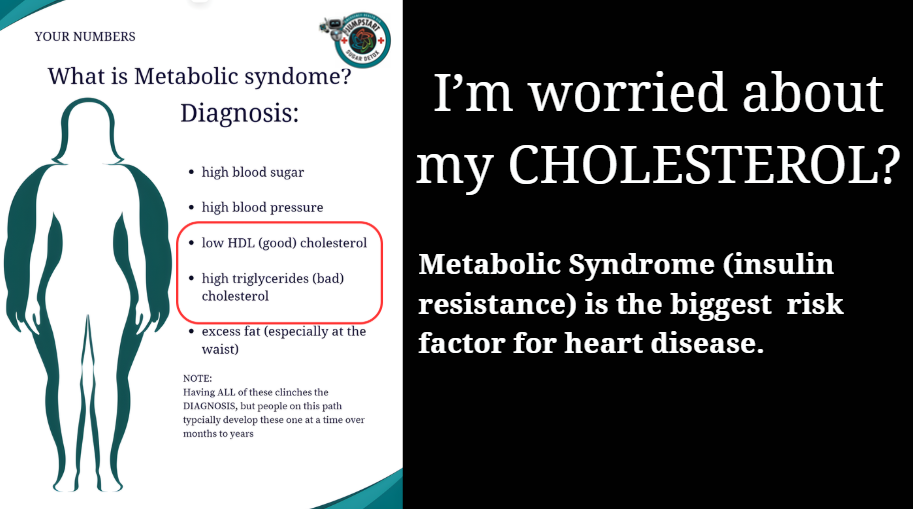
This is why I spend so much time teaching about metabolic syndrome.
Metabolic syndrome includes:
- High blood sugar
- High blood pressure
- High triglycerides
- Low HDL
- Excess abdominal fat
These problems dramatically influence cardiovascular risk.
Poor metabolic health carries a much higher risk of cardiovascular disease than high cholesterol or high LDL alone.
High cholesterol is NEVER the only thing I want to know about you.
STEP 5: Consider ApoB and Lp(a)
These are increasingly important in modern cholesterol assessment if you have known risk factors or an isolated high LDL reading despite being otherwise healthy.
ApoB
ApoB helps estimate the number of atherogenic lipoprotein particles circulating in your blood.
It can be especially useful when LDL does not seem to match the rest of your metabolic picture.
Lp(a)
Lp(a) is mostly genetic.
Lifestyle changes usually have very little effect on it.
Current recommendations suggest that every adult should have Lp(a) measured at least once.
This becomes especially important if heart attacks or strokes run strongly in your family.
STEP 6: If the answer still isn't clear, consider looking for actual plaque
Sometimes someone looks metabolically fantastic:
Great A1C.
Great triglycerides.
Great HDL.
Normal blood pressure.
Healthy weight.
Very active.
But their LDL or ApoB remains high.
Or they have a strong family history of early cardiovascular disease.
This is where a coronary artery calcium score, or CAC, may become helpful.
A CAC scan helps answer a very practical question:
Is there actually calcified plaque in the coronary arteries?
That information may help you and your doctor decide how aggressively your cholesterol needs to be treated.
🤷♀️ What about STATINS?
Statins include medications such as:
- atorvastatin, Lipitor
- rosuvastatin, Crestor
- simvastatin, Zocor
They have potential benefits for the right people.
They also have potential side effects.
And they should be prescribed based on your individual cardiovascular risk, not just for “high cholesterol”.
Someone who has already had a heart attack is very different from an otherwise healthy person who discovers an LDL of 140 during an annual physical.
Please do NOT stop a statin simply because you read something online, including something I wrote.
Instead, ask:
What is MY actual cardiovascular risk and how much will this medication reduce it?
For some people, especially those with known cardiovascular disease, the potential benefit is substantial.
For lower-risk people, lifestyle changes and further risk assessment may play a much larger role in the decision.
And statins are no longer the only cholesterol-lowering medications available.
If a statin is not tolerated, does not lower cholesterol enough, or simply is not the best choice for an individual patient, there are now several other options.
These include:
-
Ezetimibe (Zetia), which decreases cholesterol absorption from the intestine
-
Bempedoic acid (Nexletol), an oral medication that lowers LDL through a different pathway in the liver
-
PCSK9 inhibitors (Repatha, Praluent), powerful injectable medications that help the liver remove more LDL from the bloodstream
Sometimes these medications are used instead of a statin, and sometimes they are added to a statin when someone at higher cardiovascular risk needs greater LDL lowering.
This gives you and your doctor more options to individualize treatment based on your actual cardiovascular risk, your cholesterol response, medication tolerance, and how much additional lowering you really need.
What if my cholesterol rises on low carb?
First:
DON'T FREAK OUT. 🤪
Then investigate.
Look at:
- Triglycerides
- HDL
- A1C
- Blood pressure
- Weight and waist circumference
- LDL
- Non-HDL cholesterol
- ApoB
- Lp(a)
- Family history
Your overall cardiovascular risk👆
If LDL rises substantially, you may not need to abandon low-carb eating.
You may simply need to change HOW you are doing low carb.
Try advancing your healthy diet as above, with more olive oil, leaner meats, more fish and less reliance on bacon, sausage, and very fatty meats.
This is where low carb can mature into a nutrient-dense, Mediterranean-style low-carb approach.
THE BIG MESSAGE
Do not fear cholesterol. Learn how to understand it.
Total cholesterol is not enough.
LDL is not the whole story.
Triglycerides and HDL matter.
Metabolic health matters enormously.
ApoB and Lp(a) can give us additional information.
And your personal history, family history, and actual evidence of cardiovascular disease determine how aggressively you should be treated.
Cholesterol treatment should happen STEPWISE.
First, determine your risk.
Second, improve your metabolic health.
Third, look more deeply at your cholesterol when necessary.
Fourth, use medication when your individual risk and expected benefit justify it.
That is how I want my Fixed Nation clients thinking about cholesterol in 2026. ❤️
🎥 Want to learn more?
Start with my full cholesterol training video
Understanding Cholesterol: LDL Isn't Your Biggest Risk Factor
I go much deeper into the history of cholesterol, metabolic syndrome, LDL, triglycerides, HDL, statins, ApoB, and cardiovascular risk.
Then watch this excellent Metabolic Mind discussion
How One CGM Changed This Cardiologist's Life
Dr. Bret Scher interviews cardiologist Dr. Jaimela Dulaney about what happened when she began seeing insulin resistance in herself and her patients despite following a plant-based diet.
Her story is a great reminder that there is no single perfect diet for every human being. We have to look at what is actually happening to the person's metabolic health.
🤓 EXTRA CREDIT
For those who want to go deeper, here are some of the resources I have shared over the years:
My original cholesterol article:
I Have High Cholesterol, Is a Low Carb Diet Recommended for Me?
Dr. Mark Hyman:
7 Ways to Optimize Cholesterol
Dr. Ron Krauss with Dr. Bret Scher:
Diet Doctor Podcast #9: Dr. Ron Krauss
Dave Feldman:
Understanding Cholesterol and Low-Carb Lipid Responses
Dr. Paul Mason:
HDL, Triglycerides, and LDL Hyper-Response
2026 ACC/AHA Dyslipidemia Guideline:
This information is for education only. Do not start, stop, or change a prescription medication based on this article. Your cholesterol treatment should be individualized with your physician, cardiologist, or lipid specialist based on your complete cardiovascular risk profile.